Game-FullStack-Pixpet
Pixpet is a full-stack pixel-art pet-raising and card factory-building simple game based on Node.js.
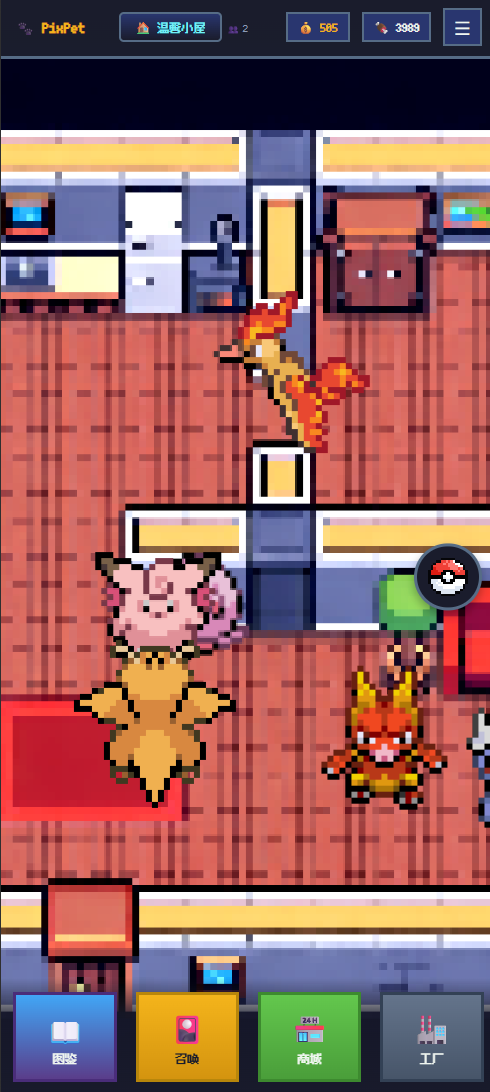
Game-FullStack-Pixpet
PixPet is a full-stack pixel-art pet-raising and factory-building game. It combines casual pet collection with intricate grid-based factory logistics management.
🎮 Gameplay Mechanics
The game revolves around two distinct yet interconnected loops: the Pet Gacha System and Automated Factory Building.
graph TD
    A[Player Coins] -->|Spend| B(Gacha System)
    B -->|Roll| C{Result}
    C -->|Keep| D[New Pet Added]
    C -->|Exchange| A
    D --> E[Place in Factory]
    E --> F[Factory Grid Operations]
    F -->|Produce| G[Resources]
    G --> A
- Pet Gacha System (Collection & Economy):
- Players obtain pets through daily-limited gacha rolls. Rolls are mathematically weighted across 7 rarity tiers (from Common up to Mythical).
- The system embraces flexibility for duplicate pulls: when obtaining a pet they already own, players make a tactical choice to either keep the duplicate or instantly exchange it for coins (exchange value scaling based on rarity).
- Pets feature personal stats like
hunger,mood, and specific size scales that individualize each pulled creature. - Also includes Inventory System, Pokédex System.
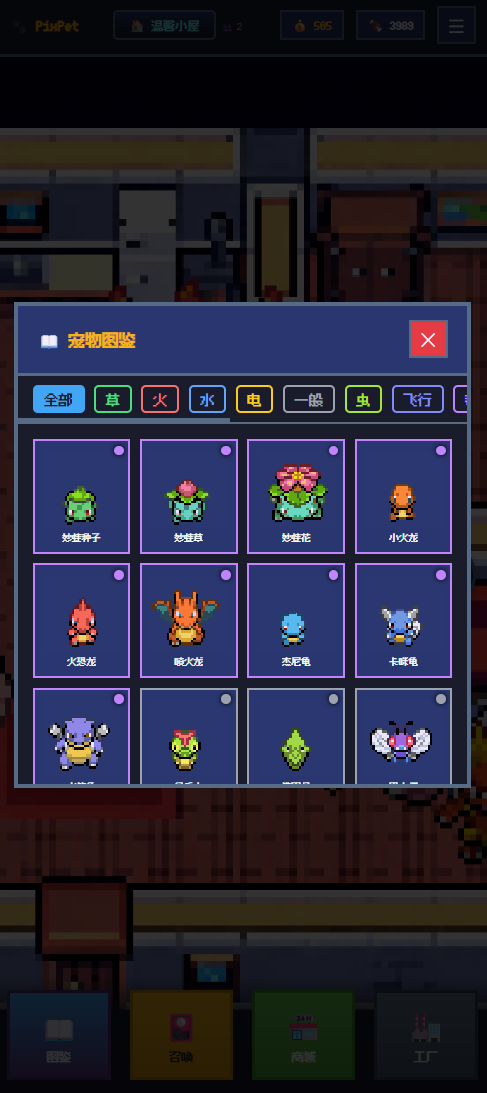
- Automated Factory Operations (Core Puzzle Mechanics):
- Elemental Production Lines: The factory operates on pet types acting as processing machines:
- Raw Materials: Grass pets produce bio raw materials; Rock pets produce ores.
- Processing: Fire pets cook bio materials and smelt ores into liquid steel.
- Precision & Output: Water and Normal pets work in tandem to transform liquid steel into parts, and output final products (
pet_foodormetal_product). - Special Nodes: Psychic pets create goods out of thin air, Ghost pets act as random multi-pliers, and other special types act as adaptable wildcards (Ditto-style).
- Buff System: Auxiliary pets provide passive boosts rather than producing goods (e.g., Bug speeds up Grass, Flying boosts Fire/Water).
- Pipeline Thermodynamics: Pipes connecting nodes generate heat when transporting items. To prevent pipes from exceeding 100 Heat and melting down, players must hook up Ice type pets which supply intrinsic cooling rates to the pipeline.
- Global Simulation Factors:
- Speed (Electricity): Electric pets supply energy. Higher electricity reduces the global tick interval, speeding up the entire factory from a base of 5 seconds per tick down to 1 second.
- Pollution: Production natively creates pollution. If global pollution hits 100%, the factory shuts down. Poison pets act as cleansers and are required to keep pollution low.
- Space (Grid Size): The factory starts with a limited grid. Placing Dragon pets permanently expands the board, allowing for grander operations.
- Output Logistics: Products must be successfully routed to edge map portals to matter:
pet_foodconverts to pet experience/satiety, whilemetal_productconverts 1:1 into player Coins.
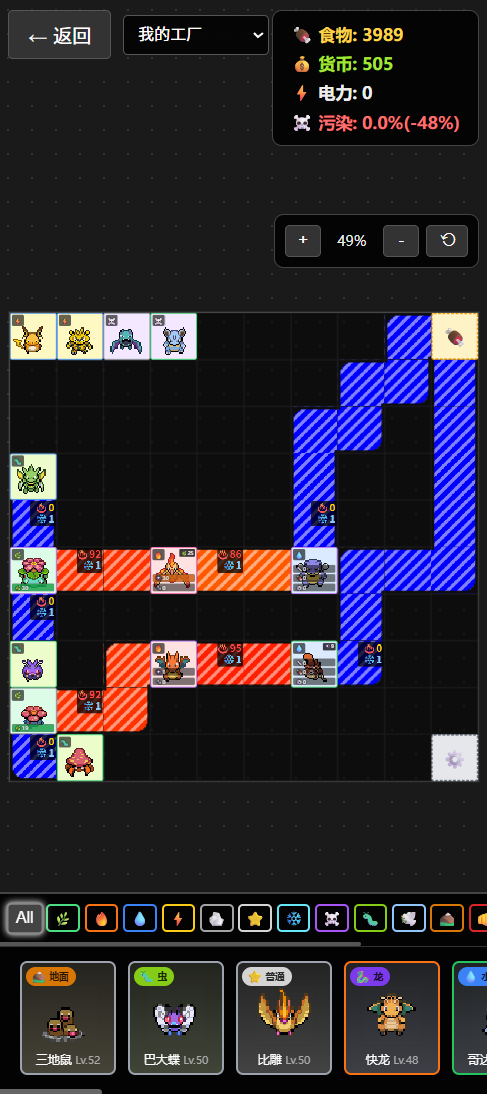
- Elemental Production Lines: The factory operates on pet types acting as processing machines:
- Social & Base Building:
- Accumulated wealth from both gacha exchanges and factory production improves the player’s overarching “Home” environment.
- Several player can share the “home”.
- Features real-time “Read-Only” visitation. Players can seamlessly query a friend’s factory layout to study their pipeline connections and cooling strategies securely, as editing interactions are disabled in spectator mode.
💻 Technical Architecture
The project adopts a modern full-stack TypeScript architecture, separating UI reactivity from pure business logic.
flowchart LR
    subgraph Frontend [Frontend: Vite + React]
        UI[React Components]
        Store[Zustand Store]
        OOP[Pure TS OOP Logic]
        UI <--> Store
        Store <--> OOP
    end
    subgraph Backend [Backend: Express + Node.js]
        Routes[API Routes]
        Services[Service Layer]
        DB[(PostgreSQL)]
        Routes <--> Services
        Services <--> DB
    end
    UI <-->|HTTP / JWT| Routes
Frontend Details
- Framework & Build: React 18 and React DOM, powered by Vite for fast client-side bundling.
- State Management: Uses Zustand extensively (e.g.,
useFactoryStore) to bridge UI Reactivity with an underlying structural OOP approach. - Object-Oriented Factory Logic: The complex factory grid uses pure TypeScript classes (like Factory, PipeChain) underlying the UI. The factory client heavily uses algorithms to calculate dynamically shaped pipe junctions (e.g.,
CROSS,T_LUR) and computes heat routing frame-by-frame tick(). - Persistence: Local storage is used as a fallback and an optimistic cache when saving factory layouts, while also regularly committing snapshots back to the server.
Backend Details
- Environment & Routing: Runs on Node.js using Express.js. In development, it leans on
tsxfor real-time TypeScript execution. - Database Architecture: Uses PostgreSQL (
pg). Schema structures are rigorously maintained usingnode-pg-migrateto ensure a consistent relational setup for users, homes, pets, and abstract factory layout JSONs. - Service-Oriented Design: The code implements a strict Service layer (e.g., factoryService.ts, gachaService.ts) separate from routes.
- Data Integrity: Financial/Gacha mechanics aggressively utilize SQL transactions (
BEGIN,COMMIT,ROLLBACK) preventing duplicate item bugs or race conditions.
- Data Integrity: Financial/Gacha mechanics aggressively utilize SQL transactions (
- Validation & Security: All incoming request payloads are type-checked linearly via Zod. Security relies on
bcryptjsfor encryption andjsonwebtokenfor stateless, scalable API authentication.
This post is licensed under CC BY 4.0 by the author.